 Aave
Aave interest rates determine supply earnings and the changing cost of borrowing
Aave interest rates determine what suppliers earn and borrowers pay in a selected lending market. Variable rates respond to utilization and configured parameters, so opening a position doesn't secure today's percentage. Compare supply income and debt costs separately, including incentives, available liquidity, and any applicable collateral risk premium.
Key takeaway: A borrowing quote describes today's cost, while utilization, market parameters, and collateral conditions determine how that cost can change.
Available liquidity limits a low-rate loan
A low borrowing rate is useful only when the market can provide the requested asset. Eligible collateral, borrowing permissions, available liquidity, and remaining borrow capacity all constrain access. A full borrow cap or restricted reserve can prevent a new loan despite an attractive quote. Supplying remains a separate choice, subject to its own permissions and capacity; it doesn't require taking on debt.
Keeping supply income separate from debt costs
Supply yield applies to the supplied balance, while borrowing interest applies to outstanding debt. These balances usually differ, so subtracting their displayed percentages doesn't establish the account's net earnings.
Earning on supplied assets
Supplying assets to a lending market can earn a variable return. The relevant comparison includes the return available on that asset, its withdrawal liquidity, and exposure to the lending contracts. Keeping tokens in a wallet avoids that lending exposure but doesn't earn Aave supply interest.
Paying for access to liquidity
Borrowing provides liquidity while collateral remains supplied. Its economic value depends on what the borrowed funds accomplish and how the debt will be repaid. Interest increases the amount owed, even when the borrower makes no further drawdowns.
To compare the account's income and expense, value both balances in a common unit over the same period. Apply each rate to its corresponding balance, then account for transaction costs and eligible rewards. If the assets differ, their relative prices also affect the outcome. A positive interest spread alone doesn't establish a profitable position.
Why do Aave borrowing rates jump?
Borrowing rates can jump when utilization moves into the steeper portion of a reserve's interest rate curve.
In the standard V3 model, utilization relates outstanding borrowing to debt plus available liquidity. The curve has a base rate and separate slopes below and above an optimal utilization point. Once utilization exceeds that point, further borrowing can become substantially more expensive. Withdrawals can also increase utilization by reducing the liquidity remaining in the reserve.
The optimal point and slopes are configurable parameters, not universal Aave percentages. Governance-authorized changes can reprice borrowing even without a large change in demand. Rate history helps distinguish an isolated spike from persistent borrowing pressure, while the curve explains sensitivity to further liquidity changes. Neither establishes the rate a position will pay throughout its lifetime.
Supplier yield reflects deployed liquidity and reserve allocation
Borrower interest funds the ordinary lending return, but suppliers don't receive the borrowing percentage on every supplied token. Some liquidity remains available rather than borrowed, and the protocol allocates part of the interest to its treasury.
In Aave V3, the reserve factor determines the share of borrower interest allocated to the market treasury. The standard strategy calculates the supply rate using the variable borrow rate, the supply utilization ratio, and the share remaining after that allocation. This relationship concerns protocol rates before any separate incentive rewards or display conversion to APY.
High utilization can therefore raise supply yield while leaving less liquidity available for withdrawal. A displayed return doesn't establish that the entire supplied balance can leave immediately. Withdrawal also depends on account collateral requirements when the supply supports outstanding debt.
APR and APY describe different annualized measures
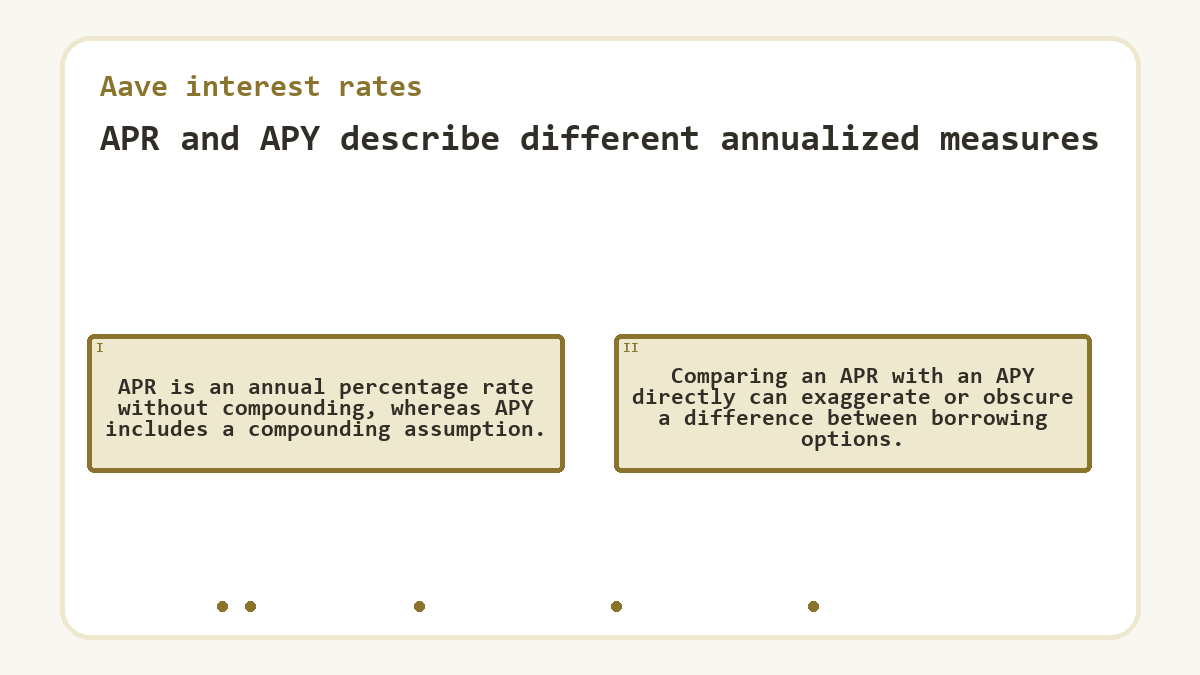
APR is an annual percentage rate without compounding, whereas APY includes a compounding assumption. Comparing an APR with an APY directly can exaggerate or obscure a difference between borrowing options.
An annualized quote expresses the current rate on a yearly basis. It doesn't mean the position has earned that amount, nor does it lock the rate for a year. Realized interest depends on the balance held, elapsed time, and the rates applied during that time. Deposits, withdrawals, repayments, and additional borrowing change the balance exposed to those rates.
For a short holding period, use a calculation suited to that period and the protocol's accrual method. Dividing a displayed APY into equal daily portions is only an approximation. Account balance changes provide a firmer measure of accrued interest once unrelated transfers and position changes are excluded.
Incentive rewards change the comparison
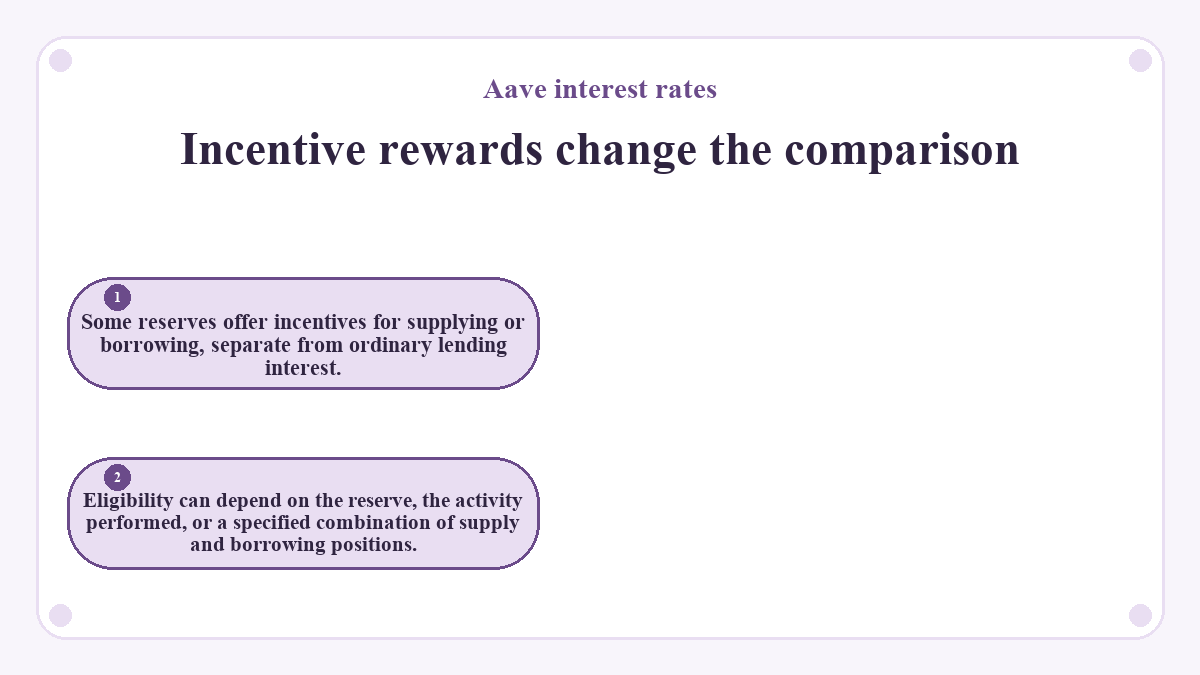
Some reserves offer incentives for supplying or borrowing, separate from ordinary lending interest. Eligibility can depend on the reserve, the activity performed, or a specified combination of supply and borrowing positions.
Separate the base rate from the reward component before comparing opportunities. A reward paid in another token introduces a separate valuation question. Claiming requirements and program conditions also affect what the account actually receives. An advertised borrowing incentive doesn't necessarily reduce the debt balance recorded by the lending contract.
Compare the position with and without those rewards. This reveals whether its economics rely on continued eligibility or an incentive remaining available. Accrued debt still needs repayment even when an expected reward hasn't become claimable.
Reviewing the rate impact before a borrow becomes debt
Consider an account comparing a larger borrowing request with a smaller request from the same reserve. The larger amount removes more available liquidity and may push utilization into a steeper part of the curve. The relevant comparison is the expected rate after borrowing, alongside the resulting account health.
| Borrow stage | Borrowing action | Borrow status and conditions |
|---|---|---|
| Prepare the request | Select the reserve and proposed amount. | A prepared request hasn't created debt. |
| Review dependencies | Check liquidity, borrowing capacity, and the projected rate impact. | The amount must be permitted and supported by collateral. |
| Submit the transaction | Authorize the accepted borrow after reviewing its effect. | A pending transaction still needs a successful execution result. |
| Reconcile the position | Compare received tokens, recorded debt, and the updated rate. | The confirmed transfer and account record must match the executed borrow. |
If the larger request produces an unacceptable projected cost, the account owner can revise the amount or decline to submit it. A smaller request still needs its own review; reducing the amount doesn't bypass reserve restrictions. When the chosen request remains eligible and its cost is acceptable, execution creates debt and transfers the borrowed tokens.
After confirmation, a different displayed rate can reflect the borrow itself or other activity affecting utilization. Missing received tokens require checking transaction status and the receiving address before another submission. A failed borrow doesn't create the requested loan, although an on-chain failure can consume a network fee.
Borrowing interest can reduce the collateral margin
Borrowing interest increases debt, which can weaken account health even when the borrower takes no additional loan. Supply interest can increase collateral value in token terms, but it doesn't necessarily offset debt growth.
In V3, health factor compares liquidation-adjusted collateral value with debt value. A value below 1 makes a position eligible for liquidation. The effect of interest therefore belongs in the borrowing decision alongside asset price movements. A modest starting rate can become costly over a long holding period, particularly when the debt grows faster than its supporting collateral.
Repayment reduces the balance on which future borrowing interest accrues. Adding eligible collateral can improve health without reducing that balance. These actions address different problems: borrowing expense and collateral coverage.
V3 reserve quotes and V4 collateral premiums differ
The protocol version changes what a borrowing quote includes. Identical asset names don't establish identical liquidity, risk parameters, or effective costs across markets.
V3 prices borrowing at the reserve level
The standard V3 variable rate comes from the selected reserve's utilization and interest rate strategy. Compare the same asset within the exact market containing the intended position. Another market can have different demand, liquidity, and configured slopes, even when both list the same token.
V4 adds a position-specific risk premium
V4 organizes liquidity through Hubs and borrowing rules through Spokes. Its effective borrowing cost incorporates the underlying borrowing rate and a risk premium associated with the position's collateral. The premium represents additional interest relative to the base rate; it isn't simply a percentage-point surcharge added to a displayed APY.
Use the effective quote for the particular position when comparing V4 options. A borrowing action can update its risk premium and applicable configuration. The lowest base quote alone therefore doesn't establish the lowest cost for the collateral the account actually supplies.
How much does moving for a lower rate save?
Moving saves money only when the interest difference over the actual holding period exceeds the costs incurred to change positions.
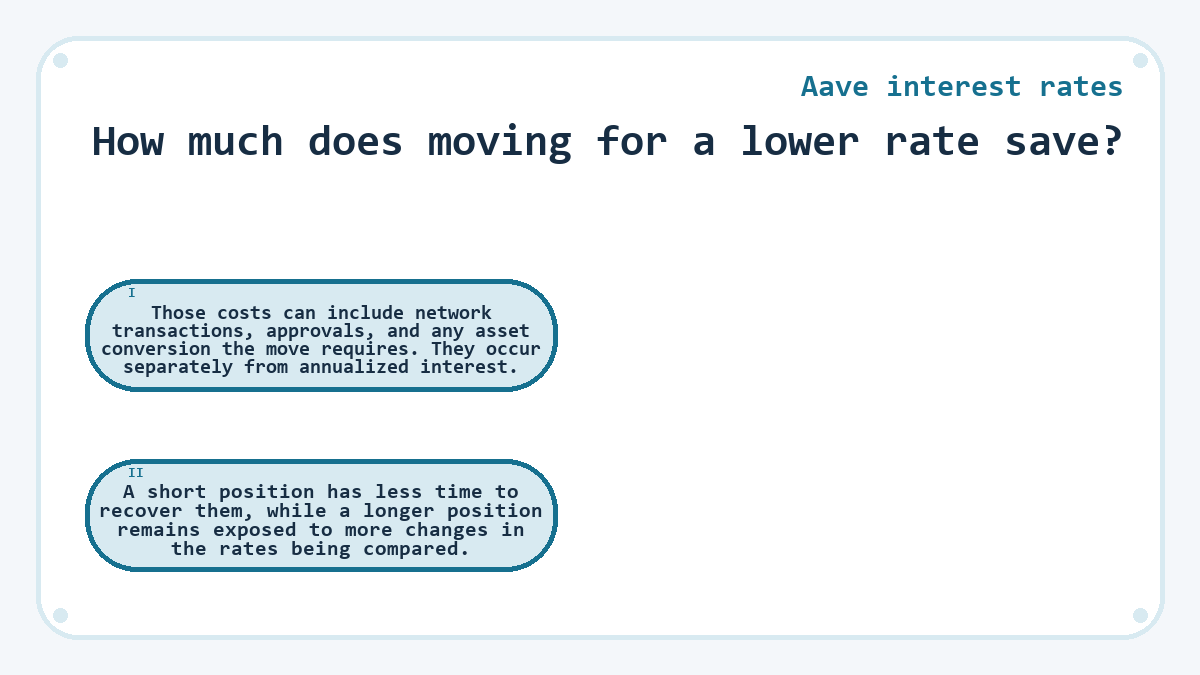
Those costs can include network transactions, approvals, and any asset conversion the move requires. They occur separately from annualized interest. A short position has less time to recover them, while a longer position remains exposed to more changes in the rates being compared.
Keep the comparison on equal terms. Match the borrowed asset, amount, expected duration, and treatment of rewards. A lower rate on a different asset also changes the repayment obligation and price exposure. That isn't a pure interest saving.
Existing debt also constrains movement because collateral supporting it may not be freely withdrawable. Some refinancing mechanisms use flash loans to reorganize positions within a transaction; their applicable fees and execution conditions are separate from ordinary borrowing APY. Compare the complete cost of the available method before treating a rate difference as recoverable savings.
Choose a rate exposure the position can support
Aave interest rates are most useful when paired with a decision about holding time and repayment capacity. A supply position needs an acceptable relationship between yield and access to funds. A borrowing position needs room for interest to accumulate and a feasible way to reduce debt if its cost rises.
The next decision is whether to accept the quoted variable exposure, reduce the intended borrowing, or leave the transaction unsubmitted. Base that choice on the selected market and account, including the projected rate impact. If the transaction proceeds, its confirmed balances become the starting point for measuring subsequent earnings and costs.
Useful questions about Aave interest rates
Can I switch a new Aave loan to the old stable borrowing mode?
The former stable borrowing option isn't an available alternative for new V3 loans. Governance disabled new stable borrowing in November 2023. Older explanations offering a choice between stable and variable debt describe earlier functionality. A stablecoin's price target also doesn't make its borrowing rate fixed; the asset and its interest rate are separate features.
When is V3 supply interest paid into my balance?
V3 supply interest appears automatically in the interest-bearing aToken balance rather than arriving as a scheduled monthly payment. The balance represents supplied principal plus accrued lending yield. Withdrawing converts the eligible amount back into the underlying asset, subject to liquidity and collateral constraints. Separate incentive rewards can have their own claiming process.
Do I pay borrowing interest in AAVE tokens?
Ordinary borrowing interest increases debt denominated in the borrowed asset. AAVE isn't a universal token used to settle interest on every loan. The relevant obligation is the outstanding balance of the particular asset borrowed, including its accrued interest. Network transaction fees are separate and follow the payment requirements of the network used.
Does supplying the same asset automatically cancel its borrowing interest?
A supply balance and a debt balance remain separate until a repayment reduces the debt. Supplying an asset you also owe doesn't automatically net the positions or remove borrowing charges. The supply can earn its applicable yield while the debt accrues its borrowing cost, so equal token amounts don't establish equal interest flows.
Why can my supply earn interest while its displayed currency value falls?
Interest increases the supplied asset balance, while the displayed currency value also depends on that asset's price. A price decline can outweigh the additional tokens earned. To distinguish lending yield from price performance, compare the underlying token balance separately from its currency valuation, accounting for any deposits, withdrawals, or transfers.
Is the V3 reserve factor deducted from my original deposit?
The reserve factor allocates a share of borrower interest to the treasury; it isn't a percentage deducted from the original deposit. The standard supply rate already reflects that allocation. Subtracting the reserve factor again from a displayed base supply rate would count its effect twice.
What happens to base supply interest if nobody borrows from a standard V3 reserve?
The standard V3 interest rate strategy returns a zero liquidity rate when the reserve has no outstanding debt. Without borrower interest, that strategy generates no base lending yield. Separate incentives or other distributions must be evaluated independently; their presence doesn't mean the reserve is earning ordinary interest from borrowers.